
DISC Styles and the Personality Wheel: A Field Guide for Business Owners
If you’ve ever taken a personality assessment at work, there’s a decent chance it was DISC. It’s one of the most widely used frameworks in business because it does something genuinely useful: it gives you a shared language for talking about behavioral differences without making it personal.
The problem is that most DISC trainings stop at the assessment. You get your results, learn your four-letter code, maybe attend a workshop, and then everyone goes back to work and forgets about it. That’s a waste.
This article is what we wish every business owner knew about DISC before they pay for the assessment. It’s not an academic breakdown of personality theory. It’s a practical guide to using DISC styles, and the personality wheel that maps them, to actually improve how your team works together.
What the DISC Personality Wheel Actually Shows You
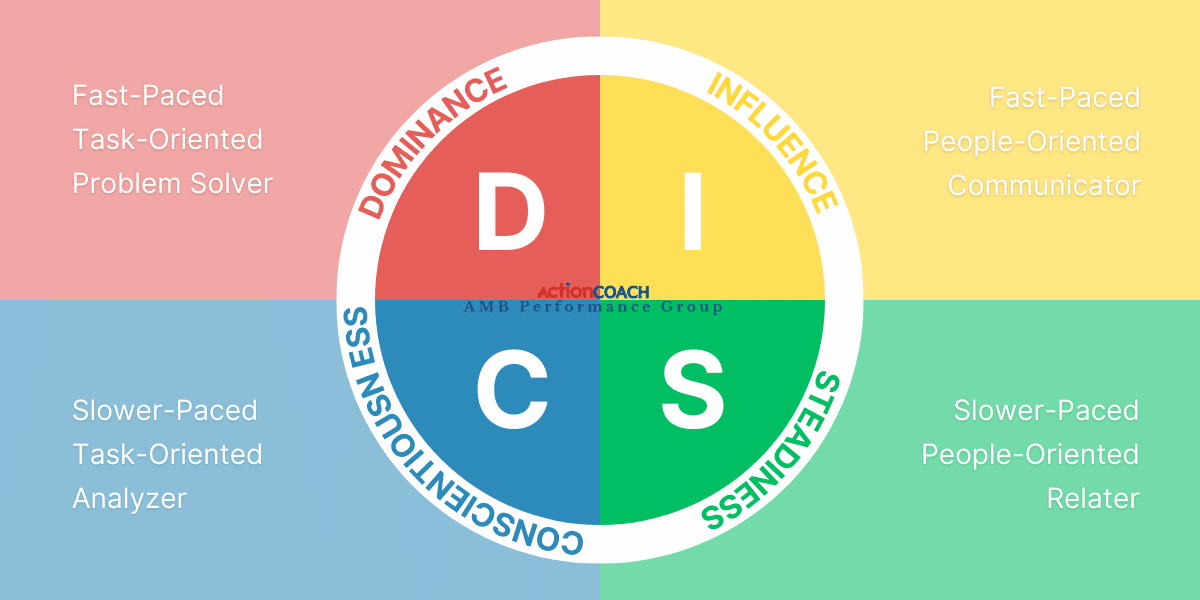
The personality wheel (sometimes called the DISC wheel or DISC assessment wheel) is a circular diagram that plots the four DISC styles around a center point. It’s not just decorative, the wheel’s structure reveals something important about how these styles relate to each other.
Here’s the layout:
D (Dominance) sits at the top. People high in D are direct, results-focused, and comfortable making fast decisions. They move quickly and don’t waste time on process they consider unnecessary.
I (Influence) sits to the right. High-I people are enthusiastic, social, and persuasive. They energize rooms, build relationships easily, and care deeply about how people feel.
S (Steadiness) sits at the bottom. High-S individuals are patient, reliable, and collaborative. They value stability, consistency, and team harmony.
C (Conscientiousness) sits to the left. High-C people are analytical, detail-oriented, and systematic. They want accuracy, clear processes, and time to think things through.
The wheel arranges these styles deliberately. Styles that sit next to each other (D and I, I and S, S and C, C and D) share some tendencies and usually communicate more easily. Styles that sit across from each other (D and S, I and C) often experience friction because their natural approaches conflict.
The DISC wheel doesn’t tell you who someone is. It tells you how they’re most likely to behave under normal conditions, and how that behavior shifts under stress.
The Personality Wheel Explained:
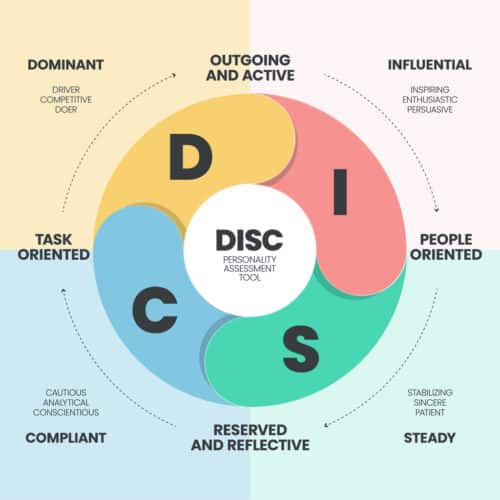
DISC infographic has 4 types of personality such as D dominant, I influential, C compliant, and S steady. Business and education concepts to improve work productivity.
Introduction to the Personality Wheel
The Personality Wheel is a comprehensive model that helps visualize the full spectrum of human personality traits. It expands on the DISC model by integrating a wider range of behavioral characteristics, providing a more holistic view of an individual’s personality.
Integration of DISC Styles
DISC styles form a crucial part of the Personality Wheel by offering key insights into core behavior patterns. Each DISC style interacts with other elements of the Personality Wheel, influencing how individuals respond to stress, teamwork, leadership, and communication challenges. By understanding where DISC styles fit within the Personality Wheel, small business owners can develop more nuanced strategies for managing and motivating their teams.
Visuals and Examples
Diagrams or infographics that map DISC styles onto the Personality Wheel can illustrate how different traits influence each other, enhancing the utility of DISC in organizational settings. These visuals can serve as practical tools for small business owners to better understand and apply personality insights in everyday business operations.
The Four DISC Styles — What They Actually Look Like at Work
Academic descriptions of DISC profiles tend to be abstract. Here’s what each style looks like when you’re sitting across from them in a meeting, working through a problem, or trying to get something done.
D — Dominance — The Driver
Core strengths: Decisive, goal-oriented, comfortable with conflict. Gets things moving when everyone else is stuck in analysis. Willing to make the call when no one else will.
Blind spots under stress: Can bulldoze over people’s input, dismiss process as bureaucracy, and alienate the team by moving too fast without buy-in. Under pressure, becomes even more controlling.
How to work with them: Be direct. Don’t waste their time with long explanations — lead with the bottom line. Give them autonomy. If you need them to slow down or consider other perspectives, frame it as a way to achieve the goal faster or with less risk.
I — Influence — The Enthusiast
Core strengths: Engaging, optimistic, excellent at building relationships and rallying people around an idea. Brings energy to the team and can sell a vision better than anyone.
Blind spots under stress: Can overpromise, underdeliver on details, and avoid difficult conversations to keep the mood positive. Under stress, becomes scattered or overly focused on being liked.
How to work with them: Keep it collaborative and upbeat. Give them room to talk through ideas. If you need follow-through, build in checkpoints — they’re not being careless, they’re just wired for big-picture thinking. Pair them with someone detail-oriented.
S — Steadiness — The Stabilizer
Core strengths: Patient, dependable, team-oriented. Excellent listeners who create calm in chaos. They’re the glue that holds teams together during transitions.
Blind spots under stress: Can resist change, avoid conflict to maintain harmony, and stay too long in situations that aren’t working. Under stress, becomes passive or quietly resentful.
How to work with them: Give them time to process change — don’t spring decisions on them. Reassure them that stability matters and that their input is valued. If you need them to move faster, explain why the change protects the team, not just the business.
C — Conscientiousness — The Analyst
Core strengths: Precise, systematic, quality-focused. Catches errors no one else sees. Builds processes that actually work because they think through edge cases.
Blind spots under stress: Can get stuck in analysis paralysis, nitpick details that don’t matter, and come across as critical or cold. Under stress, withdraws or becomes rigidly procedural.
How to work with them: Give them data and time to evaluate. Don’t rush them into decisions without letting them assess the risks. If you need them to move faster, set a clear deadline and explain the cost of delay. Respect their need for accuracy; it’s not pickiness, it’s conscientiousness.
How to Actually Use DISC With Your Team
Knowing the four styles is useful. Using that knowledge to improve how your team operates is where the value lives. Here’s how we coach business owners to apply DISC in practice.
Map your team on the personality wheel
Once everyone on your team has taken the assessment, plot where they fall on the wheel. You’ll immediately see clusters and gaps. A team that’s all D and I moves fast but might skip critical details. A team that’s all S and C is thorough but may struggle with urgency. The awareness alone changes how you assign work and structure meetings.
Adjust your communication style to the person, not to your default
If you’re high-D and you’re talking to a high-C, slow down. Give them the data. Don’t just tell them what to do — explain why it’s the right call. If you’re high-I and you’re managing a high-S, don’t overwhelm them with enthusiasm and constant change. Give them stability and let them process.
This doesn’t mean faking a personality. It means recognizing that effective communication is about what the other person needs to hear, not just what you want to say.
Use DISC to de-personalize conflict
When two people on your team clash, it’s often not about values or competence, it’s about different DISC styles operating under stress. A high-D thinks the high-S is moving too slowly. The high-S thinks the high-D is being reckless. Both are right from their own perspective.
DISC gives you a language to address this without blame. “You’re wired to move fast and she’s wired to build consensus. Neither of you is wrong, but we need to find a middle ground that gets us the urgency we need without losing the buy-in that makes implementation work.”
Recognize how stress shifts behavior
People don’t just have one DISC profile. They have a natural style and a stress style. Under pressure, high-D people often become more controlling. High-I people become more scattered. High-S people shut down. High-C people dig in on details that don’t matter.
If you know this pattern, you can catch it early. When you see someone operating from their stress profile, you know the real issue isn’t the task at hand, it’s that they’re overwhelmed. Address the underlying pressure, and the behavior usually corrects itself.
The Most Common Mistakes We See With DISC
DISC is a useful tool. It’s not a magic fix. Here’s where business owners tend to go wrong.
Using DISC to label people. “She’s a high-C, so she’s just difficult.” No. She’s detail-oriented and you’re not giving her the information she needs to feel confident in the decision. DISC explains behavior, it doesn’t excuse it, and it doesn’t turn people into caricatures.
Assuming DISC profiles are fixed. People adapt. Someone who’s naturally high-S can learn to operate with more urgency when the situation demands it. DISC describes tendencies, not limits.
Ignoring the context. DISC tells you how someone is likely to behave in typical conditions. It doesn’t account for skill, experience, motivation, or the specific dynamics of your team. Use it as one input, not the only input.
Skipping the follow-through. The assessment itself is not the work. The work is using what you learn to change how you communicate, delegate, give feedback, and structure your team. Most businesses do the assessment and then nothing changes. That’s the real waste.
One Last Thing About the Personality Wheel
The personality wheel isn’t just a diagram. It’s a reminder that the traits that make someone excellent at one thing often make them frustrating at another. The high-D who drives results can also steamroll collaboration. The high-I who energizes the team can also drop balls. The high-S who stabilizes during chaos can also resist necessary change. The high-C who catches every error can also slow momentum.
There’s no perfect profile. There’s no bad profile. There’s just a set of tradeoffs, and a team works best when those tradeoffs complement each other rather than colliding.
If you’re not sure how the DISC profiles on your team are affecting performance, communication, or culture, a Business Health Check will give you a clear read. It’s free, takes ten minutes, and it’s the same starting point we use with every coaching client.