
What is Operating Profit? Everything You Need to Know

Operating profit is the profit your business earns from its core operations, before accounting for interest and taxes. It’s calculated as: Revenue − Cost of Goods Sold − Operating Expenses = Operating Profit. Also called operating income or EBIT (Earnings Before Interest and Taxes), operating profit tells you how much money the business makes from actually running the business, separate from financing costs, tax obligations, or one-time gains and losses.
That’s the textbook answer. If you’re a business owner trying to understand what this number actually means for your decisions, keep reading.
The Formula: How to Calculate Operating Profit
Operating profit is one of the clearest measures of whether your core business model is working. Here’s the math:
Operating Profit = Revenue − COGS − Operating Expenses
Or: Operating Profit = Gross Profit − Operating Expenses
Breaking that down:
- Revenue, Total sales from your products or services
- Cost of Goods Sold (COGS), Direct costs of producing what you sell (materials, labor, production costs)
- Operating Expenses, Indirect costs of running the business (rent, marketing, salaries, utilities, insurance)
What you’re left with is the profit generated purely from operations, before you account for how the business is financed (interest on debt) or taxed.
Why Operating Profit Matters More Than Revenue
Revenue tells you how much business you’re doing. Operating profit tells you whether that business is actually profitable. A company can have $10 million in revenue and be losing money if its operating costs are too high. Or it can have $1 million in revenue and be highly profitable if its margins are strong.
Operating profit is what serious buyers, lenders, and investors look at when they’re evaluating a business. It’s the cleanest measure of operational performance because it strips out the noise, financing decisions, tax strategies, one-time asset sales, and shows you what the business does for a living.
Operating Profit vs. Net Profit: What’s the Difference?
Operating profit and net profit are related but measure different things.
Operating profit measures how much the business earns from its core operations. It excludes interest, taxes, and non-operating income or expenses.
Net profit (also called net income or the bottom line) is what’s left after everything, interest, taxes, and any other income or expense, is accounted for.
Net Profit = Operating Profit − Interest − Taxes ± Other Income/Expenses
Net profit is the final number. Operating profit tells you how well the business itself is running.
Why does this distinction matter? Because a business can have strong operating profit but weak net profit if it’s carrying a lot of debt (high interest expense) or facing a large tax bill. Conversely, a business with weak operating profit but a one-time asset sale might show strong net profit that year, but that’s not repeatable.
If you’re evaluating the health of your business or considering a sale, operating profit is the more reliable indicator of ongoing performance.
Operating Profit vs. Gross Profit vs. Net Profit
These three terms sound similar but mean different things. Here’s a quick breakdown:
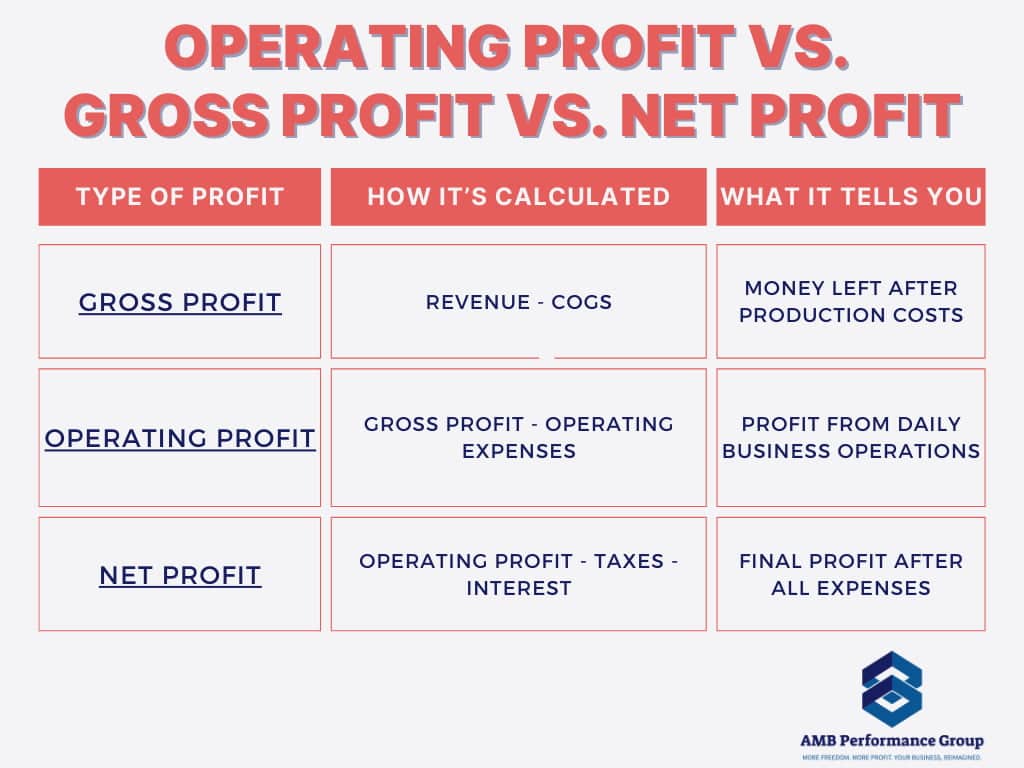 Think of gross profit as what’s left after covering the cost of making your product. Operating profit shows how much you’re making from your core business. Net profit is the final number after everything else (like taxes and loan payments) is deducted.
What Is Operating Profit Margin?
Operating profit margin expresses operating profit as a percentage of revenue. It tells you how much of every dollar in sales becomes operating profit.
Operating Profit Margin = (Operating Profit ÷ Revenue) × 100
A higher margin means the business is more efficient at converting revenue into profit.
For example: if your business generates $1 million in revenue and $200,000 in operating profit, your operating profit margin is 20%. That means 20 cents of every dollar in sales becomes profit from operations.
Industry benchmarks vary widely. SaaS companies often run 20–30% operating margins. Retail and restaurants might run 5–10%. What matters isn’t just the absolute number, it’s whether your margin is improving over time and whether it’s strong enough to support growth and reinvestment.
How Do Operating Costs Affect Profit?
Operating costs are everything you spend to run the business that isn’t directly tied to producing the product. Rent, salaries, marketing, insurance, software, utilities, these are operating expenses.
The relationship is straightforward: higher operating costs = lower operating profit, unless revenue increases proportionally.
This is why cost control matters so much. If your revenue is flat but your operating expenses keep creeping up, adding software subscriptions, expanding the team without corresponding revenue growth, taking on a bigger office space, your operating profit gets squeezed. Over time, that compression can turn a profitable business into a breakeven one.
The businesses we work with that grow operating profit consistently are the ones that manage costs deliberately. They don’t just cut expenses blindly, they evaluate which expenses directly drive revenue and which ones have become habit.
How to Increase Operating Profit
There are three levers for improving operating profit, and most businesses focus on the wrong one.
- Increase revenue without increasing costs proportionally. This is the best lever. If you can grow sales without hiring more people, expanding facilities, or significantly raising marketing spend, the incremental revenue flows almost directly to operating profit. This is why businesses with recurring revenue or scalable models tend to have strong operating margins, the second customer costs far less to serve than the first.
- Reduce operating expenses. This works, but it has limits. You can’t cut your way to sustained growth. Cost reduction is useful when you’re stabilizing a struggling business or eliminating waste, but it’s not a long-term growth strategy. If you cut too deep, you damage the capacity of the business to deliver value.
- Improve gross margin. If you can reduce COGS (through better supplier pricing, process efficiency, or waste reduction) or increase pricing without losing volume, gross profit goes up, and operating profit follows. This is often the most overlooked lever. Most business owners assume their pricing and costs are fixed. They’re not.
The most effective strategy uses all three levers in sequence: improve gross margin, control operating expenses, then scale revenue. That combination produces sustainable operating profit growth.
Common Questions About Operating Profit
What does operating profit mean?
Operating profit is the profit a business earns from its core operations, before interest and taxes. It measures how much money the business makes from actually running the business, excluding financing costs and tax obligations. It’s one of the clearest indicators of operational performance.
What is operating profit margin?
Operating profit margin is operating profit expressed as a percentage of revenue. It’s calculated as (Operating Profit ÷ Revenue) × 100. A higher margin means the business converts more of its revenue into profit. Industry benchmarks vary, but the key is whether your margin is improving over time.
What is a good operating profit margin?
It depends on your industry. SaaS and software companies often run 20–40% operating margins. Retail and restaurants typically run 5–15%. Professional services might run 15–25%. What matters more than the absolute number is whether your margin is healthy relative to your industry peers and whether it’s trending upward as you grow.
Is operating profit the same as net profit?
No. Operating profit measures profit from core operations before interest and taxes. Net profit is what’s left after all expenses, including interest, taxes, and non-operating income or expenses, are accounted for. Operating profit is the better measure of how well the business itself is running. Net profit reflects the final outcome after financing and tax strategies.
Why is it important to assess operating profit?
Operating profit tells you whether your core business model is profitable, separate from how the business is financed or taxed. It’s the number buyers, investors, and lenders focus on when evaluating a business because it reflects sustainable operational performance. If operating profit is weak, the business has a fundamental problem. If operating profit is strong, the business is built on a solid foundation, even if net profit is temporarily suppressed by debt or taxes.
The Number That Tells You If the Business Works
Revenue is a vanity metric. Net profit is influenced by financing and tax decisions that can mask operational problems. Operating profit is the number that tells you the truth: is this business actually making money from what it does?
If you’re growing revenue but operating profit isn’t growing with it, something is broken in your cost structure. If operating profit is strong and growing, you have a business worth scaling. That clarity is why operating profit matters, and why it’s one of the first numbers we look at when we start working with a new client.